-
Birmingham Library ©Rob Clayton
Birmingham, John Madin, Demolished 2016
-
Dawson Heights ©Rob Clayton
London, East Dulwich, Kate Macintosh, (LB Southwark)
-
Picadilly Plaza Restaurant ©Rob Clayton
Manchester, Covell, Matthews and Partners
-
City of London New Crematorium ©Rob Clayton
London, Aldersbrook, E G Chandler
-
Hollings Building ©Rob Clayton
Manchester, Leonard Howitt
-
Centre Point ©Rob Clayton
London, George Marsh, R. Seifert and Partners
-
HexagonTower ©Rob Clayton
Manchester, Hexagon House for ICI, Richard Seifert
-
Capital Building ©Rob Clayton
Liverpool, Lambert Smith Hampton
-
Alton Estate ©Rob Clayton
London, Rosemary Stjernstedt (LCC)
-
Welbeck Street ©Rob Clayton
London, Michael Blampied and Partners, Demolished 2019
-
Dollan Aqua Centre ©Rob Clayton
East Kilbride, Alexander Buchanan Campbell
-
Exchange Road Car Park ©Rob Clayton
Watford, Williams and Sage
-
Swansea County Hall ©Rob Clayton
Swansea, J Webb and C Quick, Glamorgan County Council
-
Space House ©Rob Clayton
London, George Marsh, Richard Seifert and Partners
-
Preston Bus Station ©Rob Clayton
Preston, Building Design Partnership
-
Salford Civic Centre ©Rob Clayton
Manchester, Cruickshank and Sewards
-
Barbican Estate ©Rob Clayton
London, Chamberlin, Powell and Bon
-
Cables Wynd House ©Rob Clayton
Edinburgh, Alison & Hutchinson & Partners
-
Hayward Gallery ©Rob Clayton
London, South Bank, Norman Engleback (GLA)
-
Trinity Gateshead Car Park ©Rob Clayton
Newcastle, Rodney Gordon, Owen Luder Partnership, Demolished 2010
-
University of Sussex ©Rob Clayton
Brighton, The Meeting House, Sir Basil Spence
-
Robin Hood Gardens ©Rob Clayton
London, Alison and Peter Smithson, Demolished 2018
-
The National Archives ©Rob Clayton
Kew, London, John Cecil Clavering
ROB CLAYTON
ROB CLAYTON
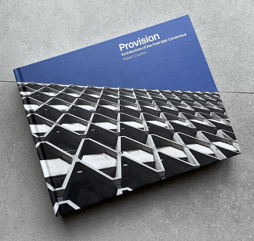
British modernist architecture is captured in Robert Clayton’s unique, sharp and graphic photographic style.
“Provision – Architecture of the Post-War Consensus” is a collection of beautiful, carefully observed colour images that present buildings in their best possible light, perhaps how they might have been first viewed on completion, when a bold new vision of modernity was being rapidly created in the post-war era. The architecture provided housing, education, leisure, health benefits in parallel with shared prosperity for all.
Examining this architectural revolution, Clayton reminds us that a different, more equal, era did exist when the built environment attempted to provide for us all and even attempted Utopia.
Beautifully captured within Robert Clayton’s photo book, produced by Stay Free Publishing its destined to be a must-have coffee table book for twentieth century architecture fans – a tome of stunning imagery that caters for the ever growing interest in this unique era of mid-century British architectural achievement. The book includes written contributions from Owen Hatherley, Barnabas Calder and Catherine Croft.
Of Robert Clayton’s book, available HERE its also received incredible accolades from some of the biggest hitters in mid century and brutalist architecture.

“Pure geometry, perfect symmetry, crisp lines, blue skies, awe inspiring angles. These are expansive images which draw us into a sense of unfolding possibility, of joy and energy”
Catherine Croft, Director C20 Society
“The beloved icons, the brutalist landmarks and the forgotten concrete gems, Robert Clayton has captured the epic sweep of British post-war architecture through his immaculate lens. A delight for fans of modernist utopias and twentieth century design.”
John Grindrod, author ‘Concretopia’
“‘Provision’ is a vision of post-war public architecture that is, unashamedly, partisan. It is not an impartial, documentary vision of modernism, but a celebration. Everything looks brilliant – colourful, optimistic, pristine. The sun is always shining. This is not accidental…but an attempt at historical redress. ‘Provision’ is an unashamedly positive vision of the architecture of the post-war welfare state with no doom”
Owen Hatherley , Journalist
Robert Clayton is a London-based freelance photographer whose work focuses on the changing urban and socio-economic landscape of Britain.